Starlink Cloud:
The Case for Orbital Computing
In January 2021, I published a concept for putting compute infrastructure into orbit using SpaceX and Starlink. Years before the industry caught on, the architecture was already mapped out.
“Been thinking about Starlinks' next big move and the concept of putting a compute cloud into orbit sounded like something that could work and would align with Elon Musk's goals. Eventually? A basic diagram to explain the layers and paths for communications is attached. I think SpaceX and Starlink are the paths to make this happen. No more data centers on earth?”
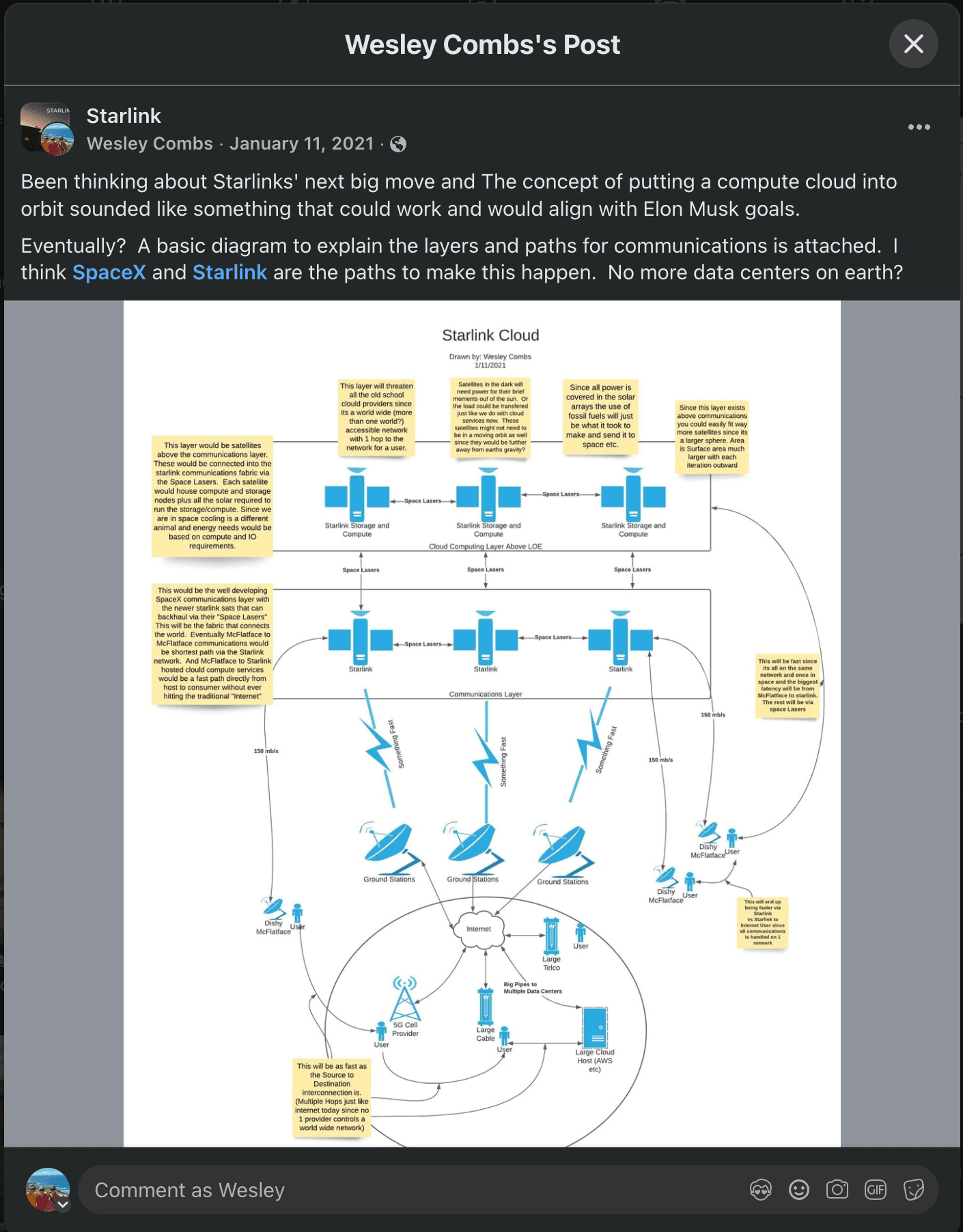
The Architecture
Three layers that could replace terrestrial data centers with orbital infrastructure.
Ground Layer
End users, IoT devices, and terrestrial networks connecting through Starlink terminals
Starlink Mesh
Satellite-to-satellite laser links forming a global low-latency backbone in LEO
Orbital Compute
Compute and storage nodes deployed in orbit, eliminating terrestrial data center dependencies
Why It Matters
Orbital computing isn't science fiction. It solves real infrastructure problems at planetary scale.
Eliminate Data Center Footprint
Data centers consume 1-2% of global electricity. Moving compute to solar-powered orbital platforms could drastically reduce terrestrial energy demands.
True Global Coverage
No more latency penalties for regions far from data center hubs. Orbital compute serves every point on Earth equally.
Laser-Link Backbone
Starlink's inter-satellite laser links already provide lower latency than fiber for long-distance routes. Add compute at the nodes and you have an orbital cloud.
SpaceX Cost Curve
Reusable rockets continue to drive launch costs down. What was prohibitively expensive in 2021 is approaching feasibility on current trajectories.
How the Industry Caught Up
What started as a concept post in 2021 became a mainstream industry direction within three years.
Wesley posts Starlink Cloud concept on Facebook
Published architectural diagram and vision for orbital compute infrastructure powered by SpaceX and Starlink.
AWS announces space-edge computing partnerships
AWS Ground Station and edge computing initiatives begin targeting satellite constellations.
Microsoft Azure Space & SpaceX partnership deepens
Azure Orbital and Starlink connectivity integrated for cloud-to-space data paths.
Orbital data centers become mainstream discussion
Multiple companies announce plans for space-based compute. The concept Wesley described in 2021 enters industry roadmaps.
Seeing what's next before it happens is what I do. Want to talk about the future?